An HVAC emergency isn't defined by how loud the system sounds or how long it's been struggling. It's defined by how quickly Florida's climate turns a failed system into conditions that are dangerous for the people inside the home, which is why top HVAC system repair near Altamonte Springs FL helps restore safety and comfort fast when it matters most.
That threshold is lower here than most national HVAC guides acknowledge — and it closes faster than most homeowners expect. After years of emergency service calls across Seminole County, the pattern is consistent: the situations that escalate most quickly aren't the ones with the most dramatic symptoms. They're the ones where a failed system meets Florida's heat, humidity, or an unexpected cold snap with vulnerable household members inside and no clear sense of what qualifies as urgent enough to call.
What we've learned directly: indoor temperatures in an unsealed Altamonte Springs home without air conditioning can exceed 90°F within hours on a July afternoon. A heating system that fails on a January night when temperatures drop into the low 40s creates a different but equally urgent set of conditions for children, elderly family members, and anyone managing respiratory or cardiovascular sensitivities. Carbon monoxide risks, electrical failures, and refrigerant leaks introduce a third category of emergency that has nothing to do with temperature and everything to do with immediate safety.
This page defines exactly where the line is — what constitutes a genuine HVAC emergency in Altamonte Springs, what separates urgent from wait-and-schedule, and what to do when conditions in your home cross that threshold. It's built on what we've seen across years of Seminole County emergency calls — not on national guidelines written for climates that don't come close to producing what Central Florida does.
TL;DR Quick Answers
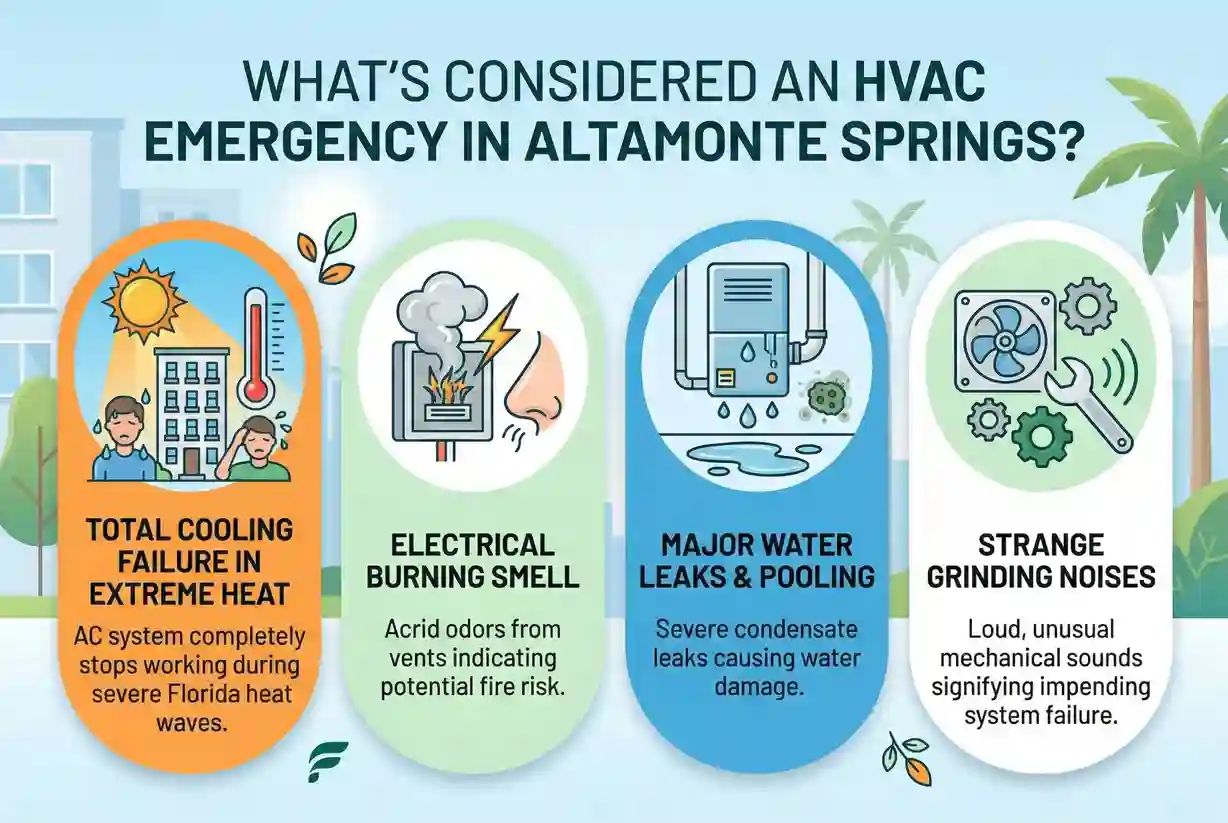
What's Considered an HVAC Emergency in Altamonte Springs Florida?
What makes an HVAC emergency different in Altamonte Springs:
Florida's sustained heat and humidity accelerate dangerous conditions faster than any moderate climate
The window between uncomfortable and dangerous closes faster than most homeowners expect
Vulnerable household members — children, elderly, anyone with heat or cold-sensitive conditions — are least able to communicate when that line has been crossed
A genuine HVAC emergency exists when:
Indoor temperatures reach 85°F or above with vulnerable household members present
A CO alarm, burning smells, visible scorch marks, or electrical arcing exist near system components
A heating failure occurs with vulnerable occupants present during forecast overnight temperatures below 45°F
A component failure creates immediate cascading damage risk that waiting will meaningfully worsen
Most dangerous scenarios we see across Seminole County:
Cooling failures where homeowners waited — uncertain conditions qualified — while indoor temperatures climbed past 88°F
Supplemental heating sources introduced during January cold snaps creating CO exposure in homes unprepared for it
Heating failures dismissed as manageable on nights temperatures dropped into the low 40s with vulnerable family members inside
Immediate action steps by emergency type:
Cooling failure:
Move vulnerable family members to cooled space immediately
Shut system off at thermostat
Call for emergency service with system off
Heating failure:
Check breaker panel first
Use electric space heaters safely away from flammable materials
Treat as emergency if overnight forecast below 45°F with vulnerable occupants present
CO, electrical, or refrigerant emergency:
Evacuate immediately
Call 911 before calling an HVAC technician
Do not re-enter until cleared by emergency personnel
Before any emergency develops:
Verify Florida DBPR license at myfloridalicense.com for your emergency contractor — now, not when you need them
Confirm working CO detectors and check batteries before cold season
Know where Seminole County cooling centers are before a July failure makes that search urgent
The one principle worth carrying from our years across Seminole County: In Florida's climate, the threshold for action should always be lower than your instinct suggests — the cost of acting when you didn't need to is an unnecessary service call — the cost of waiting when you should have acted doesn't have a repair estimate attached to it.
Top Takeaways
In Altamonte Springs, the line between uncomfortable and dangerous is shorter than most homeowners expect.
Florida's sustained heat and humidity accelerate conditions faster than any moderate climate
Children, elderly family members, and anyone with heat or cold-sensitive conditions are least able to communicate when that line has been crossed
The emergency threshold in this market needs to be lower than national HVAC guides acknowledge
The most dangerous HVAC emergencies are the ones homeowners weren't certain about.
Complete shutdowns in peak July heat are obvious — the situations that produce the most serious outcomes aren't
Homeowners who waited — uncertain whether conditions qualified — while indoor temperatures climbed in Florida's humidity produced the most serious outcomes we've seen across Seminole County
Acting before certainty costs an unnecessary service call
Waiting when action was warranted costs something that doesn't have a repair estimate attached to it
Carbon monoxide and fire risk are the HVAC emergency categories Altamonte Springs homeowners are least prepared for.
Most Central Florida homes run on electric heat pumps — creating a comfort assumption about CO risk that isn't fully warranted
Florida's short heating season means limited experience with supplemental heating sources — the most consistent source of both CO exposure and heating equipment fire risk in this market
Verify working CO detectors before cold season — not during it
Review supplemental heating safety before introducing any temporary source during a heating failure
Emergency preparedness in Altamonte Springs starts before the emergency — not after it.
Verify Florida DBPR license for your emergency contractor now — not when you need them
Know where Seminole County's cooling centers are before a July cooling failure makes the search urgent
Confirm CO detector batteries before the first cold snap of the season
Preparation that matters most in a genuine HVAC emergency almost always happened before it started
The best HVAC emergency response in Altamonte Springs is the maintenance that made the emergency unnecessary.
Pre-season inspections in September or October catch weakening capacitors, restricted filters, and degrading components before they become January emergency calls
The households facing the fewest HVAC emergencies across Seminole County aren't the ones with the newest systems
They're the ones who calibrated their maintenance schedule to what Florida's climate actually demands — not what national guidelines written for moderate markets suggest
Why Florida's Climate Redefines What Qualifies as an HVAC Emergency
Most HVAC emergency definitions are written for climates where a failed system creates discomfort. In Altamonte Springs, a failed system can create danger — and the difference between those two outcomes is measured in hours, not days. Central Florida's sustained heat, humidity, and the specific vulnerability profile of Seminole County households make the emergency threshold here meaningfully different from national guidelines written for moderate markets.
Understanding where that line is — before you're standing on the wrong side of it — is the most valuable thing this page can offer.
Cooling Failures That Qualify as HVAC Emergencies in Altamonte Springs
Not every cooling failure in Altamonte Springs is an emergency. A system that underperforms on a mild April afternoon is a scheduling call. A system that stops producing cold air on a July afternoon when indoor temperatures are climbing toward 90°F with elderly family members, young children, or anyone managing cardiovascular or respiratory conditions in the home is something entirely different.
From our years of emergency calls across Seminole County, the cooling failures that cross the emergency threshold share consistent characteristics. Indoor temperatures exceeding 85°F in homes with vulnerable occupants — children under five, adults over 65, or anyone with heat-sensitive medical conditions — meet the threshold for immediate service regardless of time of day. Heat exhaustion and heat stroke develop faster in Florida's sustained humidity than in dry heat environments because the body's cooling mechanisms become less effective when ambient humidity is high. A home without functioning air conditioning in Altamonte Springs in July is not simply uncomfortable — it is a medical risk environment for vulnerable household members within hours of failure.
The cooling emergencies we respond to most frequently across Altamonte Springs involve complete system shutdowns during peak summer heat, compressor failures that leave systems running without producing cold air, refrigerant losses that reduce cooling capacity below functional levels in high-heat conditions, and electrical failures that take down the system entirely without warning. Each of these situations warrants an emergency call when vulnerable household members are present, not a next-available appointment, and understanding tуpеs оf AC соmprеssоrs helps homeowners recognize why some failures escalate so quickly.
Heating Failures That Qualify as HVAC Emergencies in Altamonte Springs
Florida's mild winters create a specific misconception about heating emergencies: because temperatures rarely drop dramatically, homeowners often underestimate how quickly a failed heating system creates dangerous conditions for vulnerable household members on cold nights.
Altamonte Springs experiences overnight temperatures in the low 40s and occasionally the high 30s during December and January cold snaps. For healthy adults, those temperatures are uncomfortable but manageable. For infants, elderly family members, and anyone managing conditions affected by cold exposure — respiratory illness, circulatory conditions, compromised immune systems — a home dropping below 60°F overnight creates conditions that warrant immediate attention, not a morning service call.
From our emergency service history across Seminole County: heating failures that occur when overnight temperatures are forecast below 45°F with vulnerable household members present qualify as emergencies by the same standard as summer cooling failures, and that’s when HVAC system repair becomes the right call. The asymmetry most homeowners don't account for is that Altamonte Springs' short heating season means heating systems often fail on the first genuinely cold night after nine months of dormancy — exactly when demand for emergency HVAC system repair across Seminole County is highest and scheduling is most compressed.
Carbon Monoxide, Electrical, and Refrigerant Emergencies
A third category of HVAC emergency in Altamonte Springs has nothing to do with temperature and everything to do with immediate physical safety. These situations don't follow seasonal patterns and don't require vulnerable household members to qualify as emergencies — they qualify unconditionally.
Carbon monoxide is the HVAC emergency that most Altamonte Springs homeowners are least prepared for because most Central Florida homes operate on heat pumps rather than gas furnaces — and the assumption that electric systems eliminate carbon monoxide risk isn't fully accurate. Attached garages, gas water heaters sharing air handler space, and backup heat sources introduced during cold snaps create CO exposure risks that surface in HVAC service calls more often than most homeowners expect. A carbon monoxide detector alarm in a home with any gas appliance or attached garage is an unconditional emergency — evacuate first, call from outside.
Electrical failures present the second unconditional emergency category. Burning smells, visible scorch marks near the air handler or electrical panel, breakers that trip repeatedly under HVAC load, or any sign of electrical arcing in system components warrant immediate shutdown of the system and an emergency call. These situations carry fire risk that doesn't wait for business hours.
Refrigerant leaks occupy a more nuanced position. Most refrigerant used in Altamonte Springs heat pumps is not acutely toxic at typical residential exposure levels, but sustained exposure in enclosed spaces — particularly with older R-22 systems — warrants professional assessment before the system is restarted. A hissing sound from the refrigerant lines, ice formation on the refrigerant lines or evaporator coil during operation, or a sudden and complete loss of cooling capacity without an obvious electrical cause are indicators of refrigerant loss that warrant a same-day service call at minimum.
What Separates a Genuine Emergency From a Situation That Can Wait
From our years across Seminole County emergency calls, the distinction homeowners struggle with most isn't identifying obvious emergencies — it's accurately assessing the situations in between. The framework we use internally is straightforward.
A genuine HVAC emergency in Altamonte Springs meets at least one of these conditions. Indoor temperatures are reaching or exceeding levels that create medical risk for household members present. A safety risk — carbon monoxide, electrical failure, fire risk — exists independent of temperature. A heating failure occurs with vulnerable household members present during forecast overnight temperatures below 45°F. Or a system component failure creates immediate risk of cascading damage — a condensate overflow that threatens electrical components, for example — that waiting until morning will meaningfully worsen.
A situation that warrants prompt scheduling but not an emergency call typically involves a system underperforming rather than failing entirely, with no vulnerable household members present and indoor temperatures remaining below 85°F. Unusual sounds, reduced efficiency, inconsistent cooling, and comfort complaints that developed gradually almost always fall into this category — worth addressing quickly, but not at emergency service rates.
The most expensive mistake we see Altamonte Springs homeowners make in this space isn't calling for emergency service when they didn't need it. It's waiting on a situation that qualified as an emergency because they weren't certain — and finding out what several additional hours in Florida's heat or cold produced for vulnerable family members inside the home.
What to Do During an HVAC Emergency in Altamonte Springs
The actions taken in the first minutes of an HVAC emergency in Altamonte Springs directly affect both the safety outcome and the eventual repair cost. From our emergency response experience across Seminole County, the sequence that protects household members and the system most effectively is consistent regardless of the type of failure.
For cooling failures in high-heat conditions:
Move vulnerable household members to air-conditioned spaces immediately — a neighbor's home, a community center, or a cooled vehicle — before indoor temperatures reach critical levels
Close blinds and curtains to reduce solar heat gain while awaiting service
Shut the system off at the thermostat if it's running without producing cold air — a system running in failure mode can cause additional component damage
Call for emergency service with the system off and provide the technician with a description of what the system was doing before shutdown
For heating failures in cold conditions:
Use supplemental heating sources safely — electric space heaters away from flammable materials, never gas appliances indoors
Concentrate household members in a single room to retain heat more effectively
Check the breaker panel before calling — a tripped breaker is one of the most common first cold-season calls we run and resolves without a service call
If overnight temperatures are forecast below 45°F with vulnerable household members present, treat the situation as an emergency regardless of current indoor temperature
For carbon monoxide, electrical, or refrigerant emergencies:
Evacuate the home immediately — do not attempt to locate or address the source
Call 911 for carbon monoxide alarms before calling an HVAC technician
Do not restart the system after an electrical failure that produced burning smells or visible scorch marks
Call from outside the home and remain outside until emergency personnel and HVAC technicians have assessed and cleared the situation
The pattern across our Seminole County emergency calls: the households that fare best in genuine HVAC emergencies are almost never the ones that waited to be certain. They're the ones that acted on the threshold — moved vulnerable family members, shut the system down, made the call — before conditions inside the home made the decision for them.
"After years of emergency calls across Seminole County, the situations that concern us most aren't the obvious ones — complete shutdowns in the middle of July. They're the ones where a homeowner waited because they weren't certain it qualified as an emergency. Florida's climate doesn't give you the same decision window that moderate markets do. Indoor temperatures in an Altamonte Springs home without air conditioning climb faster than most homeowners expect — and for a child, an elderly family member, or anyone managing a heat-sensitive condition, the window between uncomfortable and dangerous closes faster still. The households that fare best in genuine HVAC emergencies are almost never the ones that waited for certainty. They're the ones that acted on the threshold and called for HVAC repair before Florida's climate made the decision for them."
Essential Resources
1. Verify Emergency HVAC Contractor Credentials Before Anyone Enters Your Home
Florida DBPR License Verification https://www.myfloridalicense.com/wl11.asp
Emergency urgency is the most common reason homeowners skip the verification step that protects them most — and the most common condition predatory contractors count on. We tell every Altamonte Springs homeowner the same thing we'd tell a neighbor in this situation: two minutes on this portal before scheduling emergency service is worth more than any guarantee a company offers after the fact.
Confirms active license status for any contractor legally authorized to perform HVAC work in Seminole County
Legitimate emergency contractors provide license numbers without hesitation — absence is a reason to pause, not proceed
We verify our own team's credentials the same way we encourage you to verify ours — urgency is never a reason to skip this step
2. Know the Carbon Monoxide Emergency Protocol Before You Need It
U.S. Consumer Product Safety Commission — Carbon Monoxide Safety https://www.cpsc.gov/Safety-Education/Safety-Education-Centers/Carbon-Monoxide-Information-Center
As neighbors who live and work in this community, we want every Altamonte Springs household prepared for the HVAC-adjacent emergency most Central Florida homeowners are least ready for. Most homes here run on heat pumps — but attached garages, gas appliances sharing air handler space, and supplemental heating sources introduced during cold snaps create CO exposure risks that surface in our service calls more often than most homeowners expect.
Covers CO risk scenarios specific to Central Florida homes with attached garages and gas appliances
Emergency protocol: evacuate immediately, call 911 from outside, do not re-enter until cleared by emergency personnel
Essential reading before cold season when supplemental heating sources introduce CO risk into Altamonte Springs homes for the first time in months
3. Recognize Heat-Related Illness Before Indoor Temperatures Become Critical
Florida Department of Health — Extreme Heat Safety https://www.floridahealth.gov/environmental-health/extreme-heat/index.html
Living and working in Seminole County ourselves, we know exactly what a cooling failure means on a July afternoon in Altamonte Springs — and how quickly conditions change for vulnerable household members when the system stops working. Florida DOH's guidance is calibrated to Central Florida's humidity conditions in a way that national heat safety resources aren't.
Covers heat exhaustion and heat stroke symptoms, progression, and emergency response specific to Florida's humid climate
Critical reference for households with children under five, adults over 65, or anyone managing heat-sensitive medical conditions
The window between uncomfortable and dangerous closes faster in Altamonte Springs' sustained humidity than national guidelines suggest — this resource reflects that reality
4. Find Cooling Centers and Emergency Resources Across Seminole County
Seminole County Emergency Management https://www.seminolecountyfl.gov/offices/public-safety/emergency-management/
When a cooling failure creates conditions that can't wait for a service call, knowing where Seminole County's cooling centers are before you need them is the preparation most Altamonte Springs families skip. As your neighbors in this community, we'd rather you know this resource exists now than be searching for it when indoor temperatures are climbing and vulnerable family members are inside.
Local jurisdiction covering Altamonte Springs and all Seminole County communities
Cooling center locations and emergency shelter access during extended HVAC failures and peak heat events
First local resource to consult when indoor conditions require immediate relief before a technician can arrive
5. Understand Heat Stroke and Heat Exhaustion Emergency Response
U.S. Centers for Disease Control and Prevention — Extreme Heat Prevention https://www.cdc.gov/disasters/extremeheat/heat_guide.html
In our years responding to cooling failure emergencies across Altamonte Springs, the calls that concern us most are the ones where a household member was showing heat-related illness symptoms before the call was placed. The CDC's guidance on recognizing and responding to heat emergencies is the resource we'd want every Seminole County family to have reviewed before July — not during it.
Covers heat exhaustion and heat stroke symptom recognition and emergency response protocols
Applies directly to cooling failure scenarios in Altamonte Springs homes with vulnerable household members present
Guidance on when heat-related illness requires 911 versus immediate home intervention — a distinction that matters when every minute counts
6. Use Supplemental Heating Safely During HVAC Heating Failures
U.S. Fire Administration — Home Heating Safety https://www.usfa.fema.gov/prevention/home-fires/heating-equipment/
When an HVAC heating failure on a January cold snap prompts supplemental heating use, fire risk increases in ways most Altamonte Springs homeowners don't anticipate — because Central Florida's short heating season means most households have limited experience with temporary heating sources. We share this resource because we genuinely care about what happens in your home between the moment the system fails and the moment our technician arrives.
Covers space heater safety, clearance requirements, and electrical fire prevention for temporary heating scenarios
Directly relevant to Altamonte Springs households using supplemental heating during Florida's short but genuine cold snaps
Critical reference before introducing any temporary heating source during an HVAC heating failure — fire risk doesn't wait for business hours
7. Report Predatory Emergency HVAC Pricing to the Florida Attorney General
Florida Attorney General Consumer Protection — File a Complaint https://www.myfloridalegal.com/consumer-protection/consumer-complaint-form
HVAC emergencies create exactly the conditions predatory contractors count on: urgency, stress, and a homeowner who needs the problem resolved right now. As neighbors in this community, we share this resource because we've seen what emergency pricing abuse does to Altamonte Springs families — and because we believe the contractors generating complaint filings with the Florida AG's office are the reason every homeowner in Seminole County deserves to know this resource exists before they need it.
State-level complaint process for deceptive contractor conduct during emergency HVAC service calls
Florida AG has established documented precedent acting against HVAC companies for emergency pricing abuse and unnecessary repairs
Knowing this resource exists before an emergency is more protective than finding it after a predatory service call has already been completed
These emergency resources help you get top HVAC system repair by ensuring the company you call is properly licensed and certified, guiding you through heat and carbon monoxide safety, connecting you to local Seminole County emergency support if conditions escalate, and protecting you from predatory pricing so you can act fast with confidence.
Supporting Statistics
Statistic 1: Extreme heat is the leading weather-related cause of death in the United States, killing more people annually than hurricanes, tornadoes, floods, and lightning combined. Centers for Disease Control and Prevention — Extreme Heat https://www.cdc.gov/disasters/extremeheat/heat_guide.html
What most Altamonte Springs homeowners get wrong about weather-related risk:
Most associate weather danger with hurricanes — the visible, dramatic events dominating Seminole County preparedness conversations
Extreme heat operates nothing like that
It builds quietly inside homes where air conditioning has stopped working
It develops across hours that pass before anyone recognizes conditions have crossed from uncomfortable into dangerous
What we've seen directly across Seminole County emergency calls:
The cooling failures producing the most serious outcomes are almost never the dramatic ones
They're the ones where homeowners waited — uncertain whether the situation qualified as an emergency
Walked into Altamonte Springs homes on July afternoons where the system had been down three hours
Indoor temperatures already exceeded 88°F with elderly family members inside
Nothing looked like a weather emergency from the outside — everything was one from the inside
What this statistic means for Altamonte Springs homeowners specifically:
A failed cooling system on a July afternoon is not a comfort problem
For a child under five, an adult over 65, or anyone managing cardiovascular or respiratory conditions — it is a medical risk environment
Indoor temperatures in an Altamonte Springs home climb faster in sustained humidity than in dry heat environments
The emergency threshold in this market needs to be lower than most national HVAC guides acknowledge
Extreme heat being the leading weather-related cause of death in the U.S. is the reason why
Statistic 2: Carbon monoxide poisoning accounts for more than 400 deaths and approximately 100,000 emergency room visits annually in the United States. U.S. Consumer Product Safety Commission — Carbon Monoxide Information Center https://www.cpsc.gov/Safety-Education/Safety-Education-Centers/Carbon-Monoxide-Information-Center
The number that matters most to Altamonte Springs homeowners:
Not the 400 annual deaths — it's the 100,000 annual ER visits
Those visits represent exposure events that didn't become fatalities but required immediate medical intervention
That gap between exposure and fatality is where Central Florida households are most vulnerable
The CO risk pattern we observe directly in Seminole County every winter:
Cold snap arrives in January
Heat pump dormant since February struggles or fails
Homeowner introduces supplemental heating source — portable gas heater, generator, gas appliance in heating role it wasn't designed for
Household hasn't thought about CO risk — Florida's climate makes it feel like a low-probability event
Detector batteries haven't been checked since previous winter
Garage door stays closed because it's cold outside
What makes Altamonte Springs households specifically vulnerable:
Most homes run on electric heat pumps — creates a comfort assumption about CO risk that isn't fully warranted
Responded to Seminole County service calls where CO exposure had nothing to do with the HVAC system — everything to do with how the homeowner responded to the system failing
Short heating season creates the impression that CO preparedness isn't necessary
The 100,000 annual ER visits happen in homes that weren't prepared — because the climate made preparation feel optional
Statistic 3: Home heating equipment is involved in approximately 49,000 home structure fires annually, causing an estimated 500 deaths, 1,400 injuries, and $1.1 billion in property damage. U.S. Fire Administration — Home Heating Safety https://www.usfa.fema.gov/prevention/home-fires/heating-equipment/
Why this statistic matters more in Altamonte Springs than almost anywhere else:
Central Florida households are among the least prepared in the country for supplemental heating fire risk
The reason is specific to this climate — and it's one we observe directly across Seminole County service calls
What Florida's short heating season actually produces:
6–8 weeks of meaningful heating demand per year means most households have limited hands-on experience with supplemental heating sources
In climates with 5–6 month heating seasons, households develop instinctive safety habits through repeated seasonal use
In Altamonte Springs, those habits don't develop the same way — because the equipment rarely comes out of the closet
The secondary risk pattern we see across Seminole County heating emergency calls:
The most serious secondary risks almost never come from dramatic system failures
They come from how homeowners respond to system failures
Space heater placed too close to bedding
Supplemental heat operated overnight in an enclosed room
Temporary heating sources used in ways a household accustomed to year-round air conditioning hasn't had enough experience to anticipate
What we now do differently because of what we've seen:
Supplemental heating safety is a standard part of every heating emergency response conversation we have with Altamonte Springs homeowners
The $1.1 billion in annual property damage documented by the USFA represents a risk this market is statistically less prepared for than any climate with a genuine heating season
That gap in preparedness is exactly what this statistic should communicate to every Central Florida household
Final Thought & Opinion
The most important thing we've learned after years of emergency calls across Altamonte Springs isn't how to diagnose a failed system faster. It's how to help homeowners recognize when waiting is the most dangerous decision they can make.
Florida's climate creates a specific emergency preparedness gap. It's not a lack of awareness about hurricanes or flood risk — those threats announce themselves. The gap is in recognizing that a failed HVAC system in Central Florida's sustained heat and humidity escalates from uncomfortable to dangerous faster than most homeowners realize until they're inside one.
What that gap looks like from the inside:
A homeowner waiting three hours before calling — uncertain the situation qualified as an emergency — while indoor temperatures climbed past 88°F with an elderly parent in the next room
A household introducing supplemental heating during a January cold snap without recognizing the CO exposure scenario they'd created — because eleven months without a heating need made the risk feel theoretical
A family waiting until morning to report a heating failure on a night temperatures dropped into the low 40s — because Florida winters feel mild until they don't
Our honest opinion after serving this community:
Most HVAC emergencies in Altamonte Springs aren't caused by systems that failed without warning. They're caused by homeowners who had the warning and weren't certain it was serious enough to act on.
Florida's climate doesn't reward that uncertainty the way moderate climates do:
The decision window is shorter
Conditions escalate faster
The household members most at risk — children, elderly family members, anyone managing heat or cold-sensitive medical conditions — are the least able to communicate when conditions have crossed the threshold
What the households that fare best share in common:
One consistent characteristic across every Seminole County emergency call we've run: they acted before certainty. They moved vulnerable family members, shut the system down, made the call — before Florida's climate made the decision for them.
Before any HVAC emergency develops in your Altamonte Springs home:
Verify active Florida DBPR license at myfloridalicense.com for your emergency contractor — do it now, not when you need them
Confirm working carbon monoxide detectors in any home with an attached garage or gas appliances — check batteries before cold season, not during it
Know where Seminole County's cooling centers are located before a July cooling failure makes that search urgent
Establish the filter change and pre-season inspection schedule that prevents the majority of emergency calls we run across Altamonte Springs
The opinion we'd offer every Altamonte Springs homeowner:
The threshold for action in Florida's climate should always be lower than your instinct suggests.
The cost of acting when you didn't need to: an unnecessary service call
The cost of waiting when you should have acted: measured in something that doesn't have a repair estimate attached to it
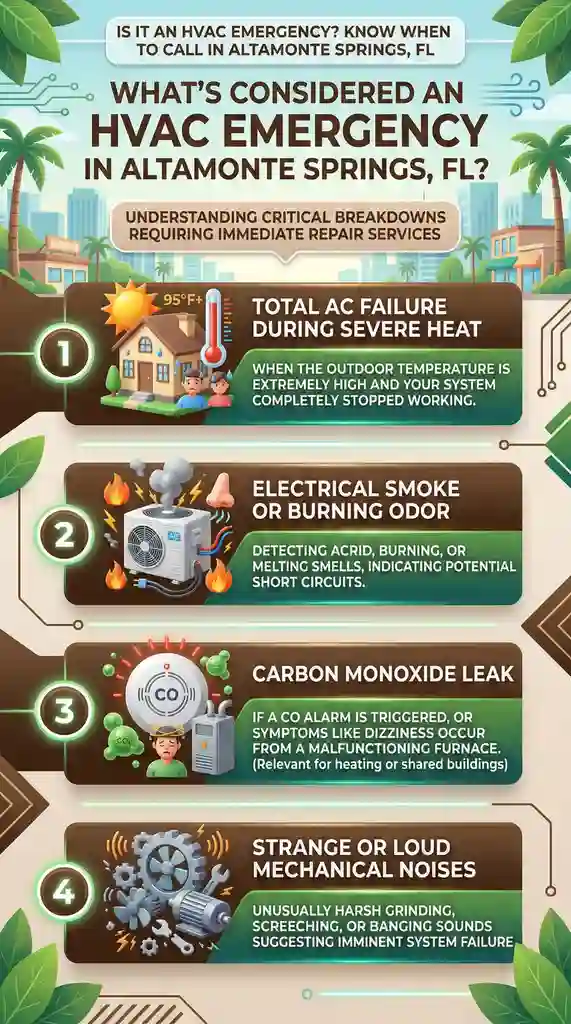
FAQ on What's Considered an HVAC Emergency in Altamonte Springs Florida
Q: What qualifies as an HVAC emergency in Altamonte Springs Florida?
A: After years of emergency calls across Seminole County, the framework we use is straightforward. Florida's climate makes each condition more urgent than the same situation produces anywhere else in the country.
A genuine HVAC emergency exists when:
Indoor temperatures reach 85°F or above with children under five, adults over 65, or anyone managing heat-sensitive conditions
A CO alarm, electrical failure, burning smells, visible scorch marks, or signs of arcing exist near system components
A heating failure occurs with vulnerable household members present during forecast overnight temperatures below 45°F
A component failure creates immediate cascading damage risk that waiting until morning will meaningfully worsen
What doesn't qualify:
System underperforming but not failing with no vulnerable occupants present
Indoor temperatures below 85°F with no vulnerable household members
Comfort complaints or unusual sounds that developed gradually
What we've seen directly across Seminole County:
Most serious outcomes almost never come from obvious emergencies
They come from homeowners who waited — uncertain conditions qualified — while Florida's climate narrowed the window
With vulnerable household members present: act before certainty, not after it
Q: How quickly can an Altamonte Springs home become dangerous during a summer cooling failure?
A: Faster than most homeowners expect. Florida's sustained humidity is the variable national heat safety guidelines consistently underestimate for Central Florida homes.
What the timeline looks like in Altamonte Springs:
Indoor temperatures can exceed 90°F within 2–3 hours on a July afternoon
Humidity above 80% reduces the body's ability to cool itself — conditions become dangerous faster than the temperature reading suggests
Heat exhaustion can develop in healthy adults within 3–4 hours above 90°F
For children under five and adults over 65 — that timeline compresses significantly
What we've walked into directly across Seminole County:
Arrived at Altamonte Springs homes where the system had been down three hours
Indoor temperatures already exceeded 88°F with elderly family members inside
Nothing looked like an emergency from the outside — everything was one from the inside
Households that fared best had already moved vulnerable family members before placing the call
The threshold worth applying:
Vulnerable household members present and temperatures climbing — don't wait for 90°F
Move vulnerable family members to a cooled space first — then call
Shut the system off — running in failure mode causes additional component damage
Every hour of delay in Altamonte Springs' summer heat narrows the recovery window
Q: What are the carbon monoxide risks associated with HVAC emergencies in Altamonte Springs Florida?
A: Carbon monoxide is the HVAC emergency category most Altamonte Springs homeowners are least prepared for. Florida's short heating season makes CO risk feel theoretical — right up until a January cold snap makes it immediate.
Why Central Florida households carry specific CO vulnerability:
Most Altamonte Springs homes run on electric heat pumps — creating a comfort assumption about CO risk that isn't fully warranted
Attached garages, gas water heaters sharing air handler space, and supplemental heating sources introduced during cold snaps create exposure scenarios we see in Seminole County service calls regularly
Eleven months without a heating need creates the impression CO preparedness isn't necessary
The pattern we observe directly across Seminole County every winter:
Cold snap arrives — heat pump dormant since February struggles or fails
Homeowner introduces supplemental heating source not designed for indoor residential use
CO detector batteries haven't been checked since the previous winter
Exposure scenario develops in a home that wasn't prepared because the climate made preparation feel optional
Unconditional emergency protocol — no exceptions:
CO detector alarm: evacuate immediately — do not search for the source
Call 911 from outside — before calling an HVAC technician
Do not re-enter until emergency personnel have assessed and cleared the situation
Verify working CO detectors and check batteries before cold season — not during it
Q: How should Altamonte Springs homeowners respond to an HVAC emergency while waiting for a technician?
A: The actions taken in the first minutes directly affect both the safety outcome and the eventual repair cost. From our emergency response experience across Seminole County, the sequence is consistent regardless of failure type.
For cooling failures in high-heat conditions:
Move vulnerable household members to a cooled space immediately — neighbor's home, community center, or cooled vehicle
Close blinds and curtains to reduce solar heat gain
Shut the system off at the thermostat — running in failure mode causes additional component damage
Call for emergency service with the system off — describe what it was doing before shutdown
For heating failures in cold conditions:
Check the breaker panel first — a tripped breaker is one of the most common first cold-season calls we run
Use supplemental heating safely — electric space heaters away from flammable materials only
Concentrate household members in a single room to retain heat
Forecast overnight temperatures below 45°F with vulnerable members present — treat as emergency regardless of current indoor temperature
For carbon monoxide, electrical, or refrigerant emergencies:
Evacuate immediately — do not attempt to locate the source
CO alarm: call 911 before calling an HVAC technician
Do not restart a system after electrical failure producing burning smells or scorch marks
Remain outside until emergency personnel have assessed and cleared the situation
Q: How can Altamonte Springs homeowners avoid predatory pricing during HVAC emergencies?
A: Emergency urgency is the most reliable condition predatory contractors count on. The homeowners who fare best are almost always the ones who completed verification before the emergency created urgency that overrode it.
Before any emergency occurs — do this now:
Verify active Florida DBPR license at myfloridalicense.com for your emergency contractor — before you need them
Confirm EPA Section 608 certification for any contractor performing refrigerant work
Identify a trusted local contractor with verified credentials before urgency makes verification feel optional
During an emergency service call — require these regardless of urgency:
Written diagnostic assessment before authorizing any repair — verbal estimates under emergency conditions are the most consistent predatory red flag we see across Seminole County
Itemized parts and labor breakdown before work begins — legitimate contractors provide this without being asked
Direct answer: are you fixing what failed or finding out why it failed?
Labor warranty on completed work and manufacturer warranty on replaced components
Emergency pricing red flags:
Pressure to authorize full system replacement without documented evidence
Refrigerant upselling beyond what the diagnosed condition requires
Verbal-only estimates with urgency pressure to authorize immediately
Reluctance to provide license number or certification documentation
If predatory conduct occurs:
Florida AG Consumer Protection: https://www.myfloridalegal.com/consumer-protection/consumer-complaint-form
Seminole County Consumer Protection: https://www.seminolecountyfl.gov/offices/county-attorney/consumer-protection.stml
Knowing these resources exist before an emergency is more protective than finding them after
In What’s Considered an HVAC Emergency in Altamonte Springs Florida?, we clarify that an “emergency” isn’t about noise or inconvenience, it’s about safety risk and how quickly indoor conditions can become unhealthy in Central Florida heat and humidity, especially when vulnerable household members are present. While true emergencies often involve total cooling failure, electrical shutdowns, or suspected refrigerant and drainage issues, many avoidable escalations start with restricted airflow, which is why having the correct filter on hand matters. Using a properly sized 20x30x1 pleated furnace filter, a compatible 12x18x1 MERV 8 HVAC air filter for routine maintenance, or a higher-efficiency MERV 13 HVAC air filter for systems designed to handle it can help stabilize airflow and reduce strain, but if replacing the filter doesn’t restore safe comfort quickly, that’s when an emergency service call is the right move.