In Central Florida's climate, the two are rarely separate problems. After years of service calls throughout Volusia County, we've learned that a system that's failing to cool is almost always a system that's failing to clean — recirculating dust, humidity, mold spores, and airborne particles through every room, every hour it runs.
What most homeowners don't realize: the repairs that restore cooling performance are often the exact same repairs that determine what their family is breathing.
We put this page together because that connection gets missed. A clogged drain line gets treated as a comfort problem when it's also a mold problem. A dirty evaporator coil gets flagged as an efficiency issue when it's also a humidity problem. Duct leaks get ignored until cooling suffers — long after attic air loaded with insulation particles and unfiltered humidity has been circulating through the home.
This page highlights how top HVAC system repair near Deltona FL directly improves indoor air quality— covering the specific repairs that address common issues, the warning signs to watch for, and why getting these repairs right is especially important in Central Florida’s climate.
TL;DR Quick Answers
Top HVAC System Repair Near Deltona FL
The most important thing Deltona homeowners get wrong: assuming a running system is a healthy one.
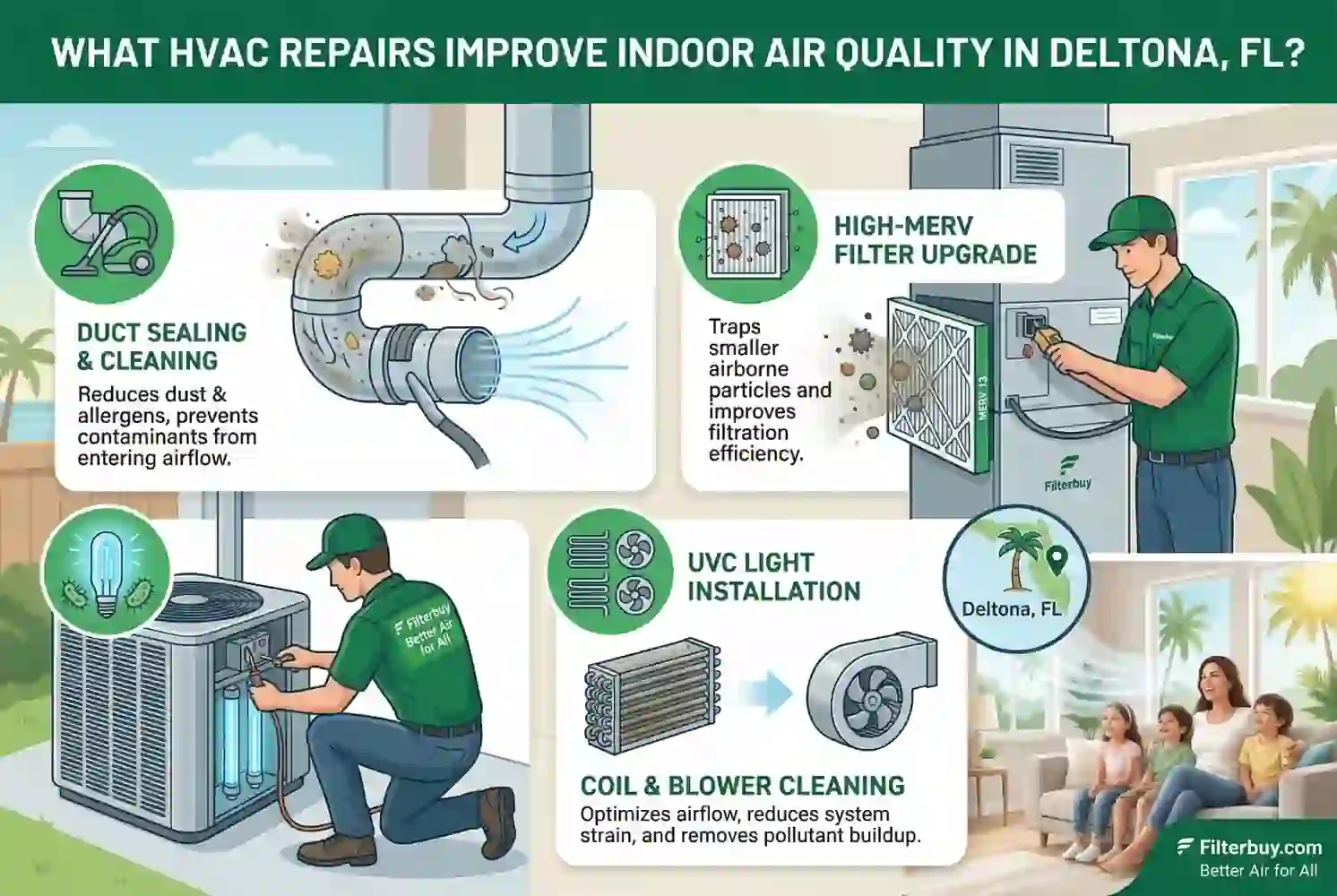
Top HVAC repairs in Deltona FL and what they actually address:
Condensate drain line clearing — prevents mold from establishing inside the air handler within 24 hours of a blockage
Evaporator coil cleaning — restores humidity control, the foundation of air quality in Central Florida homes
Duct inspection and sealing — stops attic air from bypassing filtration and entering living spaces directly
Capacitor and contactor replacement — most frequent mechanical failures in systems running year-round under sustained heat
Filter evaluation and upgrade — lowest-cost air quality intervention; must account for system airflow capacity, not just MERV rating
What separates trustworthy HVAC repair companies:
Active Florida DBPR license — verify at myfloridalicense.com
Volusia County registration — verify at volusia.org
Itemized written estimate before work begins
Permit pulled without hesitation when required
When repair stops making sense in this market:
Repair cost reaches 50% of replacement
Multiple failures within 12–24 months
System age exceeds 10–12 years
Humidity control remains inconsistent despite maintenance
How often Deltona systems need service: twice per year — spring and fall. Once-yearly national guidance wasn't written for a market where systems run most of the year under sustained heat and humidity.
The bottom line: in Central Florida's climate, HVAC repair and indoor air quality are the same conversation. The best outcomes go to homeowners who treat them that way — before a problem announces itself.
Top Takeaways
A running system is not the same as a healthy one. Cool performance doesn't reveal what's happening inside. A system can be hitting temperature while simultaneously:
Circulating mold spores from a neglected drain pan
Failing to manage humidity at the evaporator coil
Distributing unfiltered attic air through duct gaps
Deltona's climate accelerates every failure mode. What produces slow decline in a cooler market produces mold, component failure, and air quality problems in Volusia County over a single summer. Three reasons:
Year-round runtime leaves no recovery window
Sustained humidity feeds biological growth faster
Central Florida heat compresses every timeline
Indoor air quality and HVAC repair are the same conversation here. The EPA confirms indoor pollutant concentrations can be 2 to 5 times higher than outdoors. In a Deltona home with compromised filtration, unmanaged moisture, or leaking ductwork:
The family inside is the last to know
The most vulnerable members — children, elderly, anyone with asthma — are the most exposed
Over 1.2 million Florida adults already manage asthma
The highest-impact repairs are rarely the most dramatic. Three repairs that consistently deliver the greatest return in Deltona homes:
Drain line cleanings — stop the mold problem before it starts
Coil cleanings — restore humidity control before respiratory symptoms follow
Duct inspections — catch attic air infiltration before another season passes
Verify two credentials before authorizing any work. Both take under 60 seconds. Neither is optional.
Active Florida DBPR license — confirm at myfloridalicense.com
Volusia County registration — confirm at volusia.org
How a Neglected HVAC System Becomes an Air Quality Problem in Deltona
A well-maintained HVAC system does two jobs simultaneously. It controls temperature. It controls air quality. In Deltona's climate, those two functions are inseparable — and when one degrades, the other follows.
The connection most homeowners miss: every cubic foot of air in your home passes through your HVAC system multiple times per day. A system with drainage issues, dirty coils, or leaking ductwork isn't just struggling to cool. It's actively processing compromised air and redistributing it through every room.
Central Florida's heat and humidity accelerates this problem faster than most climates. Mold finds moisture. Moisture finds a neglected drain line. A neglected drain line finds your air handler — a sequence an HVAC repair expert is trained to identify early and resolve before it affects your system or indoor air quality. The sequence is predictable — and preventable.
The HVAC Repairs Most Directly Tied to Indoor Air Quality in Deltona Homes
Condensate Drain Line Cleaning and Clearing
The condensate drain line removes moisture pulled from indoor air during the cooling process. In Deltona's humidity, that line handles more volume than systems in cooler, drier climates — and clogs faster as a result.
A blocked drain line creates standing water inside the air handler. Standing water in Central Florida's heat becomes a mold and bacteria problem within days, not weeks. That mold doesn't stay in the drain pan. It enters the airstream and circulates through the home.
Warning signs:
Musty odor from vents that returns after cleaning
Water pooling near the indoor air handler
System shutting off before reaching set temperature
Visible moisture or rust around the drain pan
Evaporator Coil Cleaning
The evaporator coil is where heat and moisture are pulled from indoor air before cooled air is returned to the home. A dirty coil doesn't just reduce efficiency — it compromises humidity control, which is the foundation of air quality management in Deltona's climate.
When the coil is coated with dust, debris, or microbial growth, it loses its ability to remove moisture effectively. The result is air that feels cool enough on the thermostat but carries humidity levels that promote mold growth on surfaces, in ductwork, and in the air handler itself.
Warning signs:
Home feels humid despite the system running
Ice forming on the indoor unit
Reduced airflow from vents
Rising energy bills without change in usage
Duct Inspection, Sealing, and Repair
Duct leaks are among the most underdiagnosed air quality problems in Deltona homes. When supply or return ducts develop gaps, disconnections, or tears — common in older Volusia County homes — the system pulls air from wherever it can find it.
In most Deltona homes, that means attic air. Attic air in Central Florida carries insulation particles, elevated humidity, and in some cases mold spores from poorly ventilated spaces. That air enters the duct system, bypasses any filtration, and distributes directly into the living space.
Warning signs:
Rooms that are consistently harder to cool than others
Elevated dust accumulation despite regular cleaning
Allergy or respiratory symptoms that worsen indoors
Energy bills that don't match system runtime
Air Filter Evaluation and Upgrade
Filter selection is the lowest-cost air quality intervention available to Deltona homeowners — and the most consistently overlooked. A filter that's too restrictive for the system starves airflow and forces the system to work harder. A filter that's too permissive allows fine particles, allergens, and microbial matter to pass through uncaptured.
In Central Florida's climate, filter selection isn't a one-size-fits-all decision. Higher humidity means higher potential for mold spore circulation. More runtime means faster filter saturation. A technician who understands this market evaluates both the filter and the system's airflow capacity together — not just the MERV rating on the packaging.
Warning signs:
Filter reaching capacity faster than expected
Visible dust on supply vents
Allergy symptoms concentrated at home
System running longer cycles than normal
UV Light Installation
For Deltona homes with persistent microbial air quality issues — recurring mold growth, unexplained odors, or occupants with respiratory sensitivities — UV light installation addresses what filtration alone cannot. Installed within the air handler, germicidal UV lights neutralize mold spores, bacteria, and viruses in the airstream before they circulate through the home.
In Central Florida's climate, where moisture is a year-round factor and microbial growth finds opportunity in any neglected system component, UV light systems provide a layer of protection that works continuously — regardless of whether the underlying moisture conditions have been fully resolved.
Warning signs that UV light may be appropriate:
Recurring mold growth despite regular maintenance
Persistent musty odors with no identifiable source
Occupants with chronic allergy or asthma symptoms
Previous water intrusion near the air handler or ductwork
Why Deltona's Climate Makes These Repairs More Urgent Than Most Markets
The repairs above address air quality problems in any market. In Deltona, they address those problems on an accelerated timeline.
Central Florida's combination of sustained heat, year-round humidity, and extended system runtime creates conditions where a neglected drain line becomes a mold problem faster, where a dirty coil loses humidity control sooner, and where duct leaks pull in more compromised attic air more consistently than the same issues would produce in a cooler, drier climate.
A system that would show early warning signs over two or three seasons in a northern market can develop the same problems in a single Deltona summer. The repairs aren't different. The urgency is.
"The calls that concern us most in Deltona aren't the ones where a system has stopped working. They're the ones where a system has kept working — quietly circulating compromised air through a home for months while a family assumed that because the temperature felt right, the air did too. In Central Florida's climate, a running system and a healthy system are not the same thing. A blocked drain line producing mold in the air handler, a dirty evaporator coil that stopped managing humidity weeks ago, duct leaks pulling attic air through spaces that haven't seen a filter — none of these stop a system from running. They just change what the system is doing to the air your family breathes while it does. After years of service calls throughout Volusia County, the most important thing we've learned isn't how to fix these problems. It's how to recognize them before a homeowner has spent a season breathing the consequences."
Essential Resources
1. Start Here If Your Home Feels Cool But Doesn't Feel Right
EPA: Introduction to Indoor Air Quality We share this one with Deltona homeowners who come to us describing something they can't quite put their finger on — the house reaches temperature, but something still feels off. This is the resource that explains why a running HVAC system and a healthy one aren't always the same thing, and what the air your family breathes actually has to do with how well your equipment is maintained. EPA: Introduction to Indoor Air Quality
2. Read This Before Any Contractor Touches Your Ductwork
EPA: Should You Have the Air Ducts in Your Home Cleaned? After years of service calls throughout Volusia County, one of the questions we hear most is whether duct cleaning is worth it. This federal guide answers that honestly — including what mold contamination inside ducts actually looks like, what questions to ask any provider before work begins, and when cleaning is genuinely necessary versus when it isn't. We'd rather you go in knowing this than find out after the invoice. EPA: Should You Have the Air Ducts in Your Home Cleaned?
3. The Resource That Changed How We Think About Deltona Homes
EPA: A Brief Guide to Mold, Moisture and Your Home Living and working in Central Florida, we've seen what sustained humidity does to a home when an HVAC system stops managing moisture the way it should. This EPA guide is the one we point neighbors to when a conversation moves from repair to mold — covering drain line neglect, condensation risk, and exactly what happens inside a system when moisture problems go unaddressed. In this climate, this isn't background reading. It's essential. EPA: A Brief Guide to Mold, Moisture and Your Home
4. Three Things Every Deltona Homeowner Can Do Right Now
EPA: Improving Indoor Air Quality Not every air quality fix requires a service call. This resource covers the three levers homeowners can actually control — source reduction, ventilation, and filtration — and helps clarify something we try to explain on every visit: restoring comfort and restoring air quality don't always require the same repair. Knowing the difference helps you ask better questions and make better decisions before anyone opens your system. EPA: Improving Indoor Air Quality
5. Florida-Specific Guidance From the State Program That's Been Watching This Since the 1980s
Florida Department of Health: Indoor Air Quality Program When a Deltona homeowner's concern goes beyond standard maintenance — persistent symptoms, suspected mold, air quality issues that keep coming back after service — this is the state-level resource we refer them to. The Florida Department of Health's Indoor Air Program was built specifically for conditions like ours, and includes guidance on mold assessor and remediator licensing requirements that every Volusia County homeowner should understand before hiring anyone for remediation work. Florida Department of Health: Indoor Air Quality Program
6. The 60-Second Step We Tell Every Deltona Homeowner to Take First
Florida DBPR: License Verification Before you call anyone back — including us — verify their active Florida state license at this address. It takes under 60 seconds. In Florida, air duct cleaners are legally required to hold an air conditioning or mechanical contractor's license through DBPR. That requirement exists for a reason, and we've had too many conversations with Deltona families who skipped this step and paid for it. Confirm the license. Then make the call. Florida DBPR: License Verification
7. Most Deltona Homeowners Don't Know This Second Step Exists
Volusia County: Contractor Licensing A Florida state license and a Volusia County registration are two separate requirements — and both matter before any HVAC work begins in Deltona. This is something most homeowners only learn about after something goes wrong. We confirm both before sending our own technicians, and we'd encourage every neighbor in this area to do the same with anyone they're considering. It's a step that takes minutes and protects everything. Volusia County: Contractor Licensing
Supporting Statistics
Statistic 1: The Air Inside a Deltona Home Can Be More Polluted Than the Air Outside
The EPA reports that Americans spend approximately 90% of their time indoors — where concentrations of some pollutants are often 2 to 5 times higher than typical outdoor concentrations. US EPA
Most Deltona homeowners have it backwards.
They worry about outdoor air. They treat the house as a safe zone. When the HVAC system is healthy, that instinct is mostly right. When it isn't, a sealed, climate-controlled Central Florida home can become one of the more concentrated exposure environments a family encounters all day.
A system hitting temperature and running normal cycles can simultaneously be:
Circulating mold spores from a neglected drain pan
Distributing fine particulates a saturated filter stopped capturing weeks ago
Pulling unfiltered attic air through duct gaps no one has inspected in years
Nothing about the system's cooling performance signals any of this. The air just keeps moving.
What makes this harder to detect in Deltona than most markets:
Year-round runtime means no seasonal break where problems surface before exposure accumulates
Sustained humidity accelerates biological growth inside components homeowners never see
Sealed, energy-efficient homes keep recirculated air cycling longer before it's exchanged
The 90% figure isn't an abstract statistic. It's why we treat air handler components, filtration, and ductwork as health infrastructure — not just mechanical maintenance.
Source: EPA Report on the Environment — Indoor Air Quality
Statistic 2: Over 1.2 Million Florida Adults Currently Have Asthma — and Most Don't Know Their HVAC System Is Making It Worse
The CDC reports that in 2020, 1,276,625 Florida adults — 7.3% of the adult population — had asthma. CDC Both the CDC and the Florida Department of Health identify indoor allergens, mold, and HVAC system conditions as primary environmental triggers for asthma attacks and worsening respiratory symptoms.
The calls that stay with us longest aren't the emergency breakdowns.
They're the ones where a homeowner has been managing a respiratory condition for months — adjusting medications, scheduling doctor visits — while their HVAC system has been actively contributing to what they're experiencing.
We've found systems in Volusia County where a dirty evaporator coil had been compromising humidity control long enough that the entire air handler interior showed biological growth. The system was cooling. The family had no idea. One member had asthma that had been progressively harder to manage for the better part of a year.
That's not an anomaly. It follows a predictable sequence:
Humidity control fails quietly — usually at the evaporator coil or drain line
Moisture accumulates inside the air handler or ductwork
Biological growth enters the airstream and circulates continuously
Respiratory symptoms worsen gradually, attributed to everything except the system running overhead
In a state where more than 1.2 million adults manage asthma, and where HVAC systems run the majority of the year, system condition is a health variable. That's what the service calls teach you when you're paying attention.
Source: CDC — Florida Asthma Cooperative Agreement Partner Profile
Statistic 3: In Deltona's Climate, a Single Skipped Repair Can Become a Mold Problem Within 24 Hours
The Florida Department of Health states that when water stands for even 24 hours, common molds can take hold — and maintaining indoor humidity below 60% is one of the primary defenses against the conditions that allow mold growth to begin. Florida Department of Health
Twenty-four hours sounds like enough warning. In Central Florida, it isn't.
A blocked condensate drain line doesn't announce itself. The system keeps running. Standing water accumulates in the drain pan — in an environment with everything mold needs: heat, humidity, darkness, and a surface to colonize.
By the time a musty odor reaches a living space, growth has typically been active for days. In every one of those situations, the homeowner's response is the same: the system seemed fine.
What the 24-hour threshold means specifically for Deltona homes:
A condensate issue that might go weeks unnoticed in a drier climate becomes a mold problem over a single Central Florida weekend
The system doesn't stop running when the drain line clogs — it keeps distributing air through whatever has started growing in the pan
By the time symptoms prompt a call, a drain line clearing has often grown into a coil cleaning, a pan treatment, and a duct inspection
The Florida Department of Health is direct: if a running air conditioner still can't keep indoor humidity below 60%, the system itself needs examination. That's not a humidity problem. That's an HVAC problem wearing the humidity's face. In Deltona's climate, catching it late compounds the cost quickly.
Source: Florida Department of Health — Mold
These statistics highlight why early diagnosis and a reliable HVAC repair solution are critical in Deltona homes—because indoor air quality, humidity control, and system performance are directly connected, and even small unresolved HVAC issues can quickly develop into health and mold risks in Central Florida’s climate.
Final Thoughts
Most conversations about HVAC repair start with the wrong question.
Homeowners call asking what's wrong with their system. What they're really asking — without knowing it — is what's wrong with their air. In Deltona, those two questions almost always have the same answer.
After years of service calls throughout Volusia County, the pattern is consistent:
The homeowner noticed a symptom months before the call
They attributed it to something else — allergies, the season, getting older
The system kept running, so they kept waiting
By the time we arrived, the repair had grown into something larger than it needed to be
The running system is the problem most people don't see coming.
A broken system is easy — it stops working, the house gets hot, someone makes a call. A system that keeps running while a drain line clogs, a coil loses humidity control, or duct gaps pull in unfiltered attic air causes harm quietly. On its own schedule. While the thermostat reads exactly what the homeowner expects.
Central Florida doesn't forgive that delay the way cooler, drier markets do:
A system condition that produces slow decline in a northern home can produce a mold problem in Deltona over a single summer
Sustained heat and humidity accelerate every failure mode
We've seen it happen in a matter of weeks
Our honest opinion after serving this market:
The repairs with the greatest impact aren't always the dramatic ones. They're:
The drain line cleanings that prevent what's coming
The coil cleanings that restore humidity control before respiratory symptoms start
The duct inspections that catch attic air infiltration before another season passes
The homeowners who get the best outcomes aren't the ones with the newest systems or the highest budgets. They're the ones who asked the second question first — what is my system actually doing to my air — and rely on a top HVAC repair service to ensure their system supports clean, healthy indoor air.
FAQ on Top HVAC System Repair Near Deltona FL
Q: What are the most common HVAC repairs in Deltona FL homes?
A: Equipment running most of the year under Central Florida heat and humidity wears differently than equipment anywhere else. These are the repairs we respond to most throughout Volusia County.
Most frequent repairs and typical costs:
Condensate drain line clearing: $75–$250
Capacitor replacement: $150–$350
Contactor replacement: $150–$350
Evaporator coil cleaning: $100–$400
Refrigerant recharge: $200–$600
Blower motor replacement: $350–$700
Thermostat replacement: $150–$450
Compressor replacement: $1,200–$2,500
The pattern matters more than any single repair. Capacitor failure, then contactor, then refrigerant loss within 18 months isn't bad luck. It's a system signaling decline that parts replacement alone won't fix. The contractors worth calling in this market read that pattern honestly — even when the honest answer costs them the repair job.
Q: How do I know when repair stops making sense and replacement becomes the better decision?
A: The standard threshold is 50% of replacement cost. In Deltona's climate, frequency is the more reliable signal.
Replacement deserves serious consideration when:
Repair cost approaches or exceeds 50% of a new system
Multiple component failures occur within 12–24 months
System age exceeds 10–12 years
Energy bills keep rising despite completed repairs
Humidity control stays inconsistent regardless of maintenance
Age means something different in this market. A 12-year-old Deltona system has absorbed runtime stress a same-age system in a cooler climate hasn't faced. Before authorizing a major repair on an aging system:
Check Duke Energy rebate eligibility at duke-energy.com
Replacement becomes the more financially sound decision more often than most homeowners expect
Q: What HVAC repairs have the biggest impact on indoor air quality in a Deltona home?
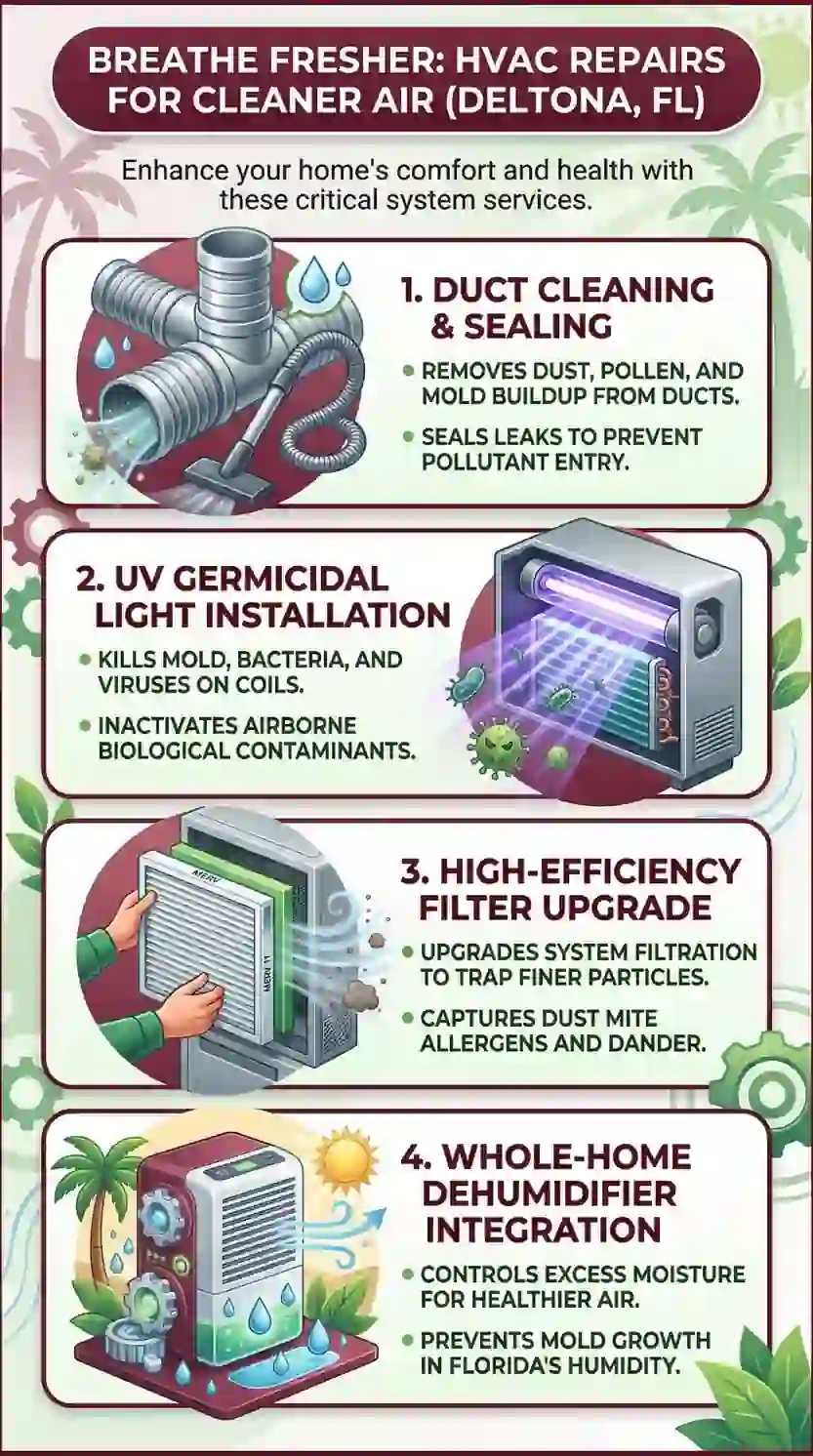
A: The repairs most directly tied to what a family breathes are consistently the ones deferred longest. Four repairs with the greatest air quality impact:
Condensate drain line clearing — blocked drain creates standing water in the air handler. Mold establishes within 24 hours in Deltona's heat and humidity. The system keeps running the entire time, distributing what's growing through every room.
Evaporator coil cleaning — dirty coil loses humidity control. Air feels cool enough while carrying moisture levels that promote mold growth on surfaces and inside ductwork. We've found systems where this had been occurring for months before anyone connected indoor air symptoms to the equipment.
Duct inspection and sealing — leaking ducts pull attic air into living spaces, bypassing filtration entirely. In most Deltona homes that means elevated humidity, insulation particles, and biological material from spaces that haven't seen a filter or inspection in years.
Filter evaluation and upgrade — lowest-cost air quality intervention available and most consistently overlooked. The right filter for a Deltona home accounts for system airflow capacity alongside MERV rating. High-MERV filters can starve systems not designed to handle the restriction — trading one problem for another.
Q: How often should HVAC systems be serviced in Deltona compared to the rest of the country?
A: Twice per year. Once-yearly national guidance wasn't written for a market where systems run most of the year.
What twice-yearly maintenance catches that annual service misses:
Refrigerant drift before it becomes an emergency recharge
Drain line buildup before it becomes a mold problem
Airflow degradation before it becomes a blower motor replacement
Coil contamination before it compromises humidity control for an entire season
What skipping a service call costs in this market:
Compressor failure in August
Drain line backup damaging ceilings or floors
Mold problem that started at the air handler and spread through ductwork
Emergency call on the system's schedule instead of yours
The homeowners we worry about most follow once-a-year national guidance — from a source that wasn't accounting for Central Florida — and assume they've done everything right. In this climate, that gap between general guidance and what this market actually requires is where most preventable problems originate, especially when it comes to understanding tуpеs оf AC соmprеssоrs and how they perform under Florida’s demanding conditions.
Q: What should I look for when evaluating HVAC repair companies near Deltona FL?
A: Two verifications before the first callback. Two conversations before anyone opens the system. One document before work begins.
Two verifications — both under 60 seconds, both non-negotiable:
Active Florida DBPR license — confirm at myfloridalicense.com. Current/Active status with HVAC-specific coverage.
Volusia County registration — confirm at volusia.org. Separate from state licensure. Both required.
Two conversations before a panel comes off:
Ask whether a permit is required. A contractor who hesitates or suggests the homeowner pull it themselves has answered a different question — about how they operate when things go wrong.
Ask for an itemized written estimate. A bundled number is not an estimate. Every legitimate repair breaks down by part, labor, and scope.
One document before work starts:
Written, itemized estimate with parts, labor, and scope clearly stated. The only protection a Deltona homeowner has when a disagreement surfaces after the job is done.
Licensure confirms legal authority to work in Florida. It doesn't confirm that a technician understands what sustained heat and humidity does to equipment in this market. That knowledge only comes from time here. It's worth asking about directly.
Improving indoor air quality often begins with identifying the HVAC components that affect airflow, filtration, and moisture control, which is exactly what What HVAC System Repairs Will Improve Indoor Air Quality in Deltona FL? explores in detail. The article explains how repairs to drain lines, coils, and airflow systems can reduce humidity-related contaminants and improve the quality of the air circulating through your home. Alongside these repairs, maintaining clean air filters plays a critical role in keeping pollutants from circulating through the system. Using options like 16x20x2 pleated furnace air filters helps capture dust and airborne particles while maintaining proper airflow. Similarly, 20x25x1 MERV 11 HVAC AC furnace air filters offer stronger filtration for allergens and fine particles that affect indoor air quality. Homeowners can also consider replacement HVAC furnace air filters to keep systems operating efficiently between maintenance visits. When combined with the repair strategies discussed in the article, proper filtration helps Deltona homeowners maintain cleaner air and a healthier indoor environment year-round.